
A version of this walk-through plays out in almost every warehouse eventually: someone paces off the last open stretch of floor and does the math on how much more stuff needs to fit. The space comes up short. Racks get pushed closer together, and aisles get a little tighter. And finally, someone looks up and asks, “What if the extra room was over our heads the whole time?”
That’s usually where the vertical lift module and the vertical carousel enter the conversation.
Both systems trade floor space for ceiling height while bringing the inventory to the operator instead of sending the operator out to find it. Many people assume the two are interchangeable, but they’re built around two different ideas of what “access” means on a working floor.

Consider Your Access Needs First
There’s one question always worth answering first: how often do you really need to get into this inventory?
Someone pulling various SKUs every few minutes, all day, needs something different than someone storing bulk stock that gets touched once a week. Looking at the two broadly:
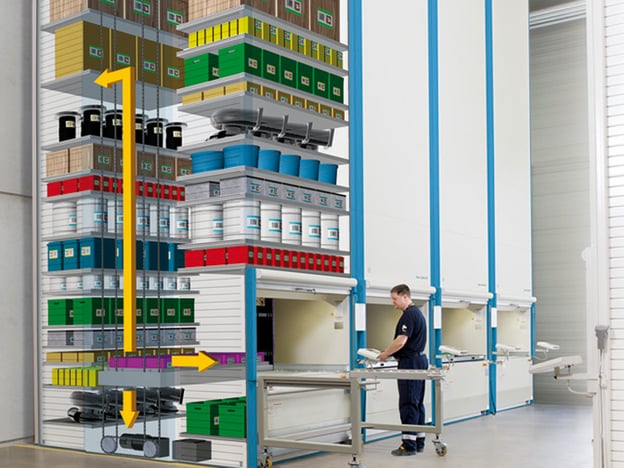
- Vertical lift module (Hänel Lean-Lift) offers a column of enclosed trays stacked on a central rail, floor to ceiling, inside its own frame. A single inserter/extractor rides that rail, pulls the tray you need, and delivers it to one access opening. Best suited to a wide, mixed inventory picked one item at a time.
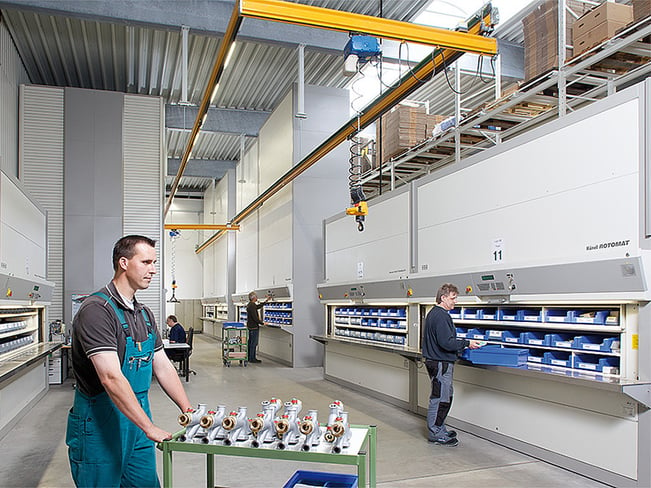
- Vertical carousel (Hänel Rotomat) offers carriers mounted on a continuous oval track (think of giving your inventory a ride on a Ferris wheel) rotating past a fixed access opening. The shelf you need comes to you, and the ones you don’t stay in motion until their turn. Best suited to a more uniform inventory picked often and repeatedly.
Footprint and Ceiling Fit
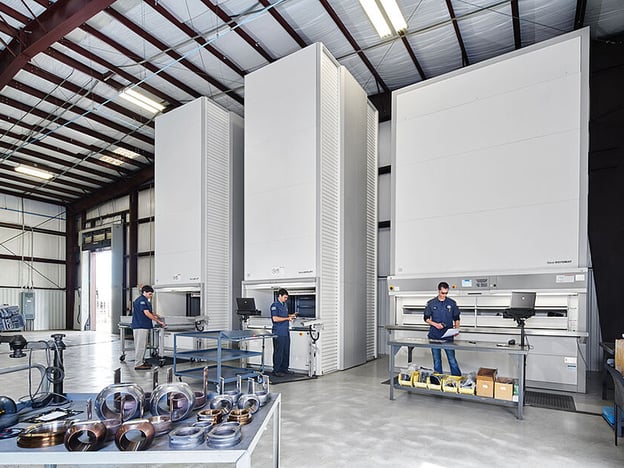
Vertical lift modules run narrower and deeper, and they scale with ceiling height. Because the inserter/extractor travels the full height of the unit on a vertical rail, a taller space adds more storage on the same slab footprint. You’ll even see these installed as freestanding units up against an exterior wall or outside the building entirely.
A vertical carousel asks more of your floor plan. Because the carriers rotate on an oval track, the unit’s proportions run wider and shorter relative to a lift module of a similar capacity. That makes carousels the better fit for lower-clearance spaces such as a mezzanine or a converted office floor.
Inventory Fit
Inventory is where the systems really diverge.
A vertical lift module is built for range. Because each tray is an independent, load-rated platform served by the same extractor, a single unit can carry small parts on one tray and a heavy pallet-scale load two trays down.
That flexibility is why lift modules show up in manufacturing and industrial settings with mixed inventory (e.g., spare parts, tooling, subassemblies, finished goods).
A vertical carousel better suits inventory that’s more uniform, easily hand-picked, and lighter per unit (e.g., files, records, small parts bins, supplies, tooling inserts). Carrier shelving is configurable with dividers, bins, and drawer inserts, which makes a carousel more of a precision-picking tool.
Access and Workflow
These two systems create very different days for their users.
A vertical lift module is built around retrieval accuracy. You request an item, the extractor finds the tray, delivers it to the access opening, and you pick from it. That’s a natural fit for order-picking environments where each request might be a different SKU and accuracy matters as much as speed. The tradeoff is you’re waiting on one extractor.
A vertical carousel is built around volume and fast, repetitive retrieval. That makes it good for bulk-parts environments, kitting, or any job where the same handful of items get picked often across a shift. Multiple carousels can also run in parallel, which matters when throughput is the actual constraint.
Automation and Controls
A vertical lift module typically runs on inventory management software, either as a standalone system or tied into what
you’re already running. Requests come in by keypad or barcode scan, and the software tracks what’s in every tray in real
time.
A vertical carousel offers touch-button retrieval that spins the right carrier into position. There’s less software depth, which means a new operator can be trained on the controls in minutes.
The Case for Going Vertical
Going vertical reclaims floor space, cuts the walking out of retrieval, and tightens security and inventory accuracy because both systems are enclosed and access-controlled.
Choose a vertical lift module if:
- Your inventory spans a wide range of sizes and weights, from small parts to heavy loads.
- Your building has ceiling height to spare and floor space to reclaim.
- Your picking pattern is order-driven with different SKUs, verified individually.
Choose a vertical carousel if:
- Your inventory is more uniform (e.g., parts, files, supplies, small components) and doesn’t need a wide weight range on one machine.
- Your ceiling height is limited.
- Your workflow involves frequent, repetitive picks where retrieval speed matters most.
- Running several units in parallel makes sense for your volume.
Some operations need both systems: a lift module for the bulk and mixed-size inventory, a carousel for the high-frequency small stuff sitting next to it.
Common Questions Before You Decide
We’ve worked with enough industrial clients that we hear the same handful of questions almost every time:
Can one system do both jobs?
Technically yes, but it’s not recommended. Each system’s advantage comes from being built around one kind of workflow. Stretching it to cover the other kind means giving up the thing that made it worth installing.
Which one is faster?
Depends on what you’re measuring. A lift module is faster at finding the exact tray out of a large, varied inventory. A carousel is faster at repeating the same retrieval motion across a shift.
How much space does a vertical storage system save?
The answer depends on what you’re replacing and how you configure the unit. Still, across Lean-Lift (VLM) and Rotomat vertical carousel installations, clients typically see up to 60% more storage capacity in the same physical footprint.
Can we start with one unit and add more later?
Yes, for either system, if the initial layout accounts for it. But adding capacity after the fact almost always costs more than planning room for it up front.
What does installation disrupt?
Both systems are typically installed against an interior or exterior wall without touching the building’s structure, but there’s still a footprint to clear and, depending on the unit, a foundation or reinforcement to confirm.
Only Looking Up from Here
Vertical lift modules and vertical carousel storage answer the same problem. The right choice comes down to what’s on your shelves and how your people move through a shift.
Need help deciding? Invite one of our consultants out. We’ll walk the floor and ask a few questions about your inventory and workflow. We can go vertical from there.