
Slow service in a pharmacy often traces back to layout.
A tech walks to the back for items that should sit within arm’s reach, and bags pile up because the rail ran out of room. Deliveries clutter the aisle because nobody’s had time to break them down. With more products and services squeezed into the same square footage, pharmacy casework determines how well that space holds up under pressure.
To understand how pharmacy storage helps workflow keep up, follow a prescription through a retail pharmacy and look at what casework and pharmacy workstations do at each stop.

How does pharmacy casework design affect workflow efficiency?
Most of a pharmacy’s daily work happens at its counters, workstations, and storage, and those are usually built from modular casework. Where each piece sits and what it holds shape how far staff walk, how often they reach, and how many times a prescription changes hands.
A good layout puts each step of the fill process next to the one before it and keeps supplies at the point of use. Modular casework can also be rearranged when the workflow changes, which, in a pharmacy, happens often.

How do you optimize a pharmacy layout for prescription fulfillment?
When planning a pharmacy layout for prescription fulfillment, start with the path a prescription takes from drop-off to will-call and place each zone next to the one that feeds it. Keep the pharmacist’s station central, with clear sightlines, and keep bulk storage and receiving behind the fill area.
Stop 1: Drop-off and consult
Drop-off is where customers form their first impression of the pharmacy, and it’s often when they share details they’d rather the person behind them didn’t hear. Privacy matters here more than anywhere else at the counter.
Consult areas can be built into the counter or set apart with partitions or movable walls. Casework at drop-off should also be easy to approach for customers using a wheelchair or mobility aid.
Pro tip: Plan the consult area for the services you expect to offer. A corner sized for quick questions can feel tight once it’s hosting vaccinations and health screenings. Keeping storage close by also means a pharmacist can grab a handout or a sample device without walking away mid-conversation.
Stop 2: Bulk and general storage
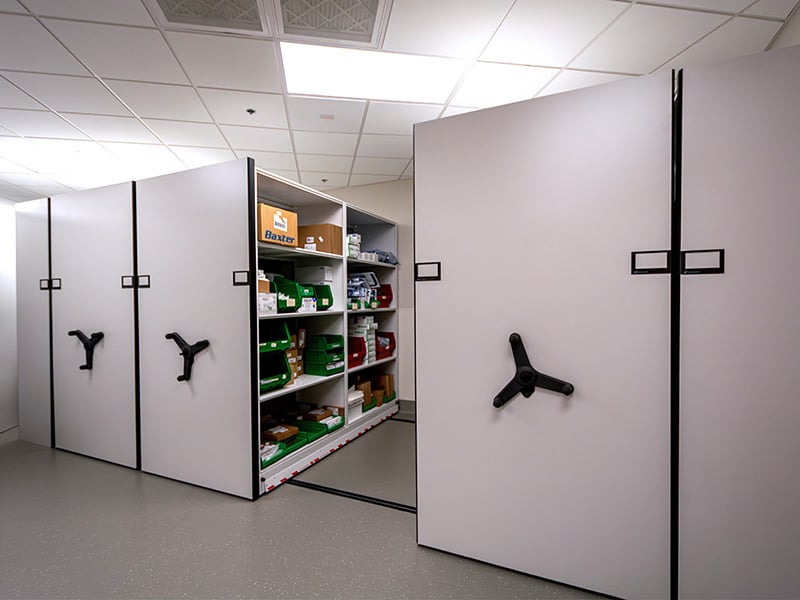
Many pharmacies follow a simple rule: no cardboard beyond this point. Deliveries get broken down in bulk storage, and only product moves forward toward the fill area.
High-density mobile shelving fits more overflow stock into a smaller room and frees square footage for the work that happens up front. Four-post shelving makes sense where access is constant and space is less tight. Be sure to leave open room for staging and unboxing.
General storage sits between bulk storage and quick pick. It holds the stock techs pull from throughout the day to refill quick pick, and the main decision here is open shelving or enclosed casework.
Four-post shelving works well for stock that needs fast, open access. For stock you’d rather keep covered, adjustable shelves and organizing modules or laminate cabinets from our modular casework line keep dust off and can be reconfigured as package sizes change.
Pro tip: Watch where deliveries land in the first hour after the truck comes. If boxes sit on the floor, the staging area is too small or in the wrong place.
Stop 3: Quick pick
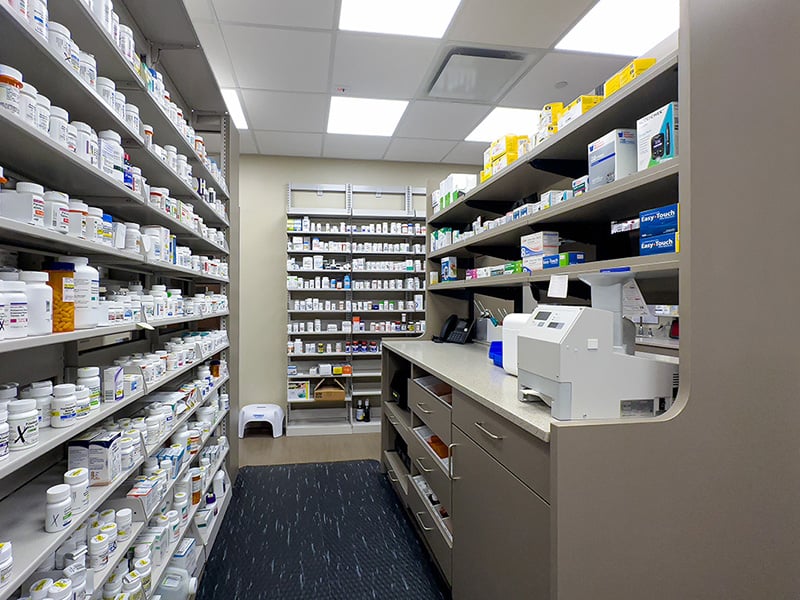
Quick pick is the shelving closest to the fill stations, stocked with the medications techs reach for the most. Pharmacy shelving systems have the biggest effect on dispensing speed here because shelving sets how far techs reach and walk for every item.
Fast-moving medications should sit within arm’s reach of the people filling them. Bin shelving keeps them there, in clear or color-coded bins that let techs spot the right product at a glance. Add tilt-down shelving, which angles stock toward the user, so nobody has to stretch or dig.
Your top sellers will change with the season (and sometimes with the news cycle). Because bin shelving uses tool-free adjustable rails, your team can move bins and re-slot products without waiting on a work order.
Pro tip: Before you label anything, ask your techs how they look for a product, then label to match.
Stop 4: Technician workstations
Pharmacy workstations handle two different jobs: technicians fill prescriptions, and pharmacists check them. This stop covers the first.
Technicians need room for printers, label stock, bagging supplies, and trash. If those don't have a designated spot, they take over the work surface. Trash cans in particular have a way of ending up wherever there’s floor.
Tech stations built from modular casework can make room for all of it: a printer shelf below the counter, a pull-out for bagging supplies, a trash cutout in the work surface, and wall-mounted shelving above for items that don’t need to be at elbow height. Clear counters lead to fewer mix-ups and a smoother handoff to the pharmacist.
Decide early whether techs will share stations or work in zones, since shared stations need storage that makes sense to everyone on every shift.
Pro tip: Stand at a tech station during a rush and notice how often someone turns around or walks away to grab something. Each of those trips points to storage that belongs at the point of use.
Stop 5: Pharmacist workstations
The pharmacist checks every prescription before it leaves, so this workstation needs to support focused work while keeping the whole floor in view. Give pharmacists their own zone, separate from tech stations, so verification doesn’t get interrupted by bagging traffic. Seated-height workstations and lower casework keep sightlines open across the pharmacy.
Locking drawers keep controlled substances and other sensitive items secure. Modular drawer systems with pull-out drawers keep pill bottles organized and easy to see, and the drawers can be re-divided as inventory shifts.
Pro tip: Ask pharmacists what else needs a home at their station, such as a second monitor, a label printer, reference binders, or a trash bin. Plan for it now so it doesn’t end up balanced on the edge of the counter later.
Stop 6: Will-call
Will-call is the last stop, where a bag either reaches the right person quickly or holds up the line while someone hunts for it.
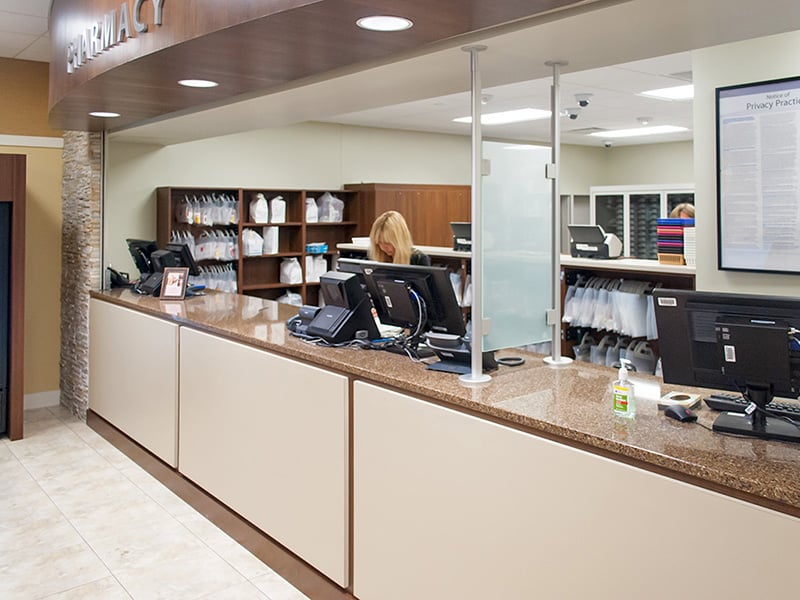
Hanging bag rails keep filled prescriptions in alphabetical order and visible at a glance. Vial drawers handle smaller orders that could get lost on a rail, and cantilever shelving takes bulkier items. Pharmacy casework with built-in bag rails brings all of it into one footprint behind the counter, so staff can find a bag without leaving the register.
Pro tip: Size will-call for your busiest week of the year. If bags spill onto the counter every fall, the rail needs more room.
Pharmacy workflow best practices: A four-part checklist
Once you’ve walked the full route, check the layout against these four themes.
- Flow: Each step of the fill process should sit next to the one before it. Look for places where people cross paths or backtrack.
- Adaptability: Services and staffing change over time. Choose casework and shelving that can be re-slotted or moved without a remodel.
- Cleanability: Clutter slows work and makes it harder to stay compliant. Laminate surfaces wipe down quickly, and closed storage keeps dust off stock.
- Access & security: Mark clearly where staff-only space begins. Use locking drawers and cabinets where medications and patient information are kept, and give staff secure lockers for their own belongings.
This checklist can also work for hospital pharmacies. They follow many of the same workflow principles as retail pharmacies, and modular casework adapts to both inpatient and outpatient work areas.
Let us walk your pharmacy with you
Take two modules and call us in the morning. Or skip the wait and schedule a walkthrough today. Patterson Pope’s healthcare team will walk your pharmacy zone by zone to recommend the casework and the pharmacy workstations that fit each area.