
Most of a museum’s collection never makes it into a gallery. In fact, museums typically display only 1% to 5% of what they hold, according to curators at London’s V&A.
The rest waits in back-of-house storage, protected and cataloged, and out of sight. Plenty of objects have been waiting for their close-up longer than most of the staff have worked there. Museum visible storage changes that by turning the storage itself into the exhibit.
What Is Museum Visible Storage?
Museum visible storage, also called open storage, is a way of displaying collections as they’re kept: grouped, dense, and in far greater numbers than a curated gallery allows. Objects sit in glass-fronted cabinets, on open shelving, or on pull-out racks that visitors can see into, rather than behind closed doors.
Museums of all sizes are making the shift, from dedicated visible storage wings to teaching collections that double as classrooms. That only works with storage designed for both jobs: keeping objects safe and keeping them in view.

How Does Open Storage Impact Museum Visitor Engagement?
Open storage gives visitors more to see, more context for what they’re seeing, and more reasons to come back. Instead of a few dozen highlights, visitors see the scale of a collection, how objects relate to one another, and the care that goes into keeping them.
Some of the world’s largest museums are built around that idea:
- Depot Boijmans Van Beuningen in Rotterdam opened in November 2021 as the world’s first publicly accessible art storage facility. Visitors can browse more than 150,000 objects and watch conservators at work. Before the Depot opened, only about 8% of the collection was on display.
- V&A East Storehouse in London opened in May 2025 with more than 250,000 objects. Its “Order an Object” experience lets visitors book time to see items up close, and the museum reported a “phenomenal response,” from art students to wedding planners.
You don’t need a purpose-built building to get the same effect. Visible storage puts more of the collection to work on any scale.
Objects that would rarely rotate into a traditional exhibit get seen every day, and researchers, students, and repeat visitors have more to come back for. It can also help with fundraising: a well-organized storage area shows donors exactly what their support protects.
Visible Storage in a Teaching Collection
At the University of Central Florida’s School of Visual Arts and Design, artworks in “The Vault,” a storage room of just over 600 square feet, had been placed wherever there was space.
After a full inventory, the room was redesigned with Spacesaver art racks, mechanical-assist mobile shelving, 4-post, wide-span, cantilever shelving, textile rods, and locally fabricated carts for flat files.
The Vault now holds sculpture up to seven feet tall, paintings, photographs, and an African mask collection, organized well enough to teach from. “I can bring down students and faculty and let them experience the artwork for themselves,” says UCF Art Gallery Director Shannon Lindsey.
What Should You Look for in Museum Display Cabinets?
The best museum display cabinets protect objects from dust, water, and handling while keeping them in clear view. Museum cabinets are the backbone of most visible storage galleries, so look for museum cabinets with glass doors and sealed construction.
Spacesaver museum cabinets add two specific protections: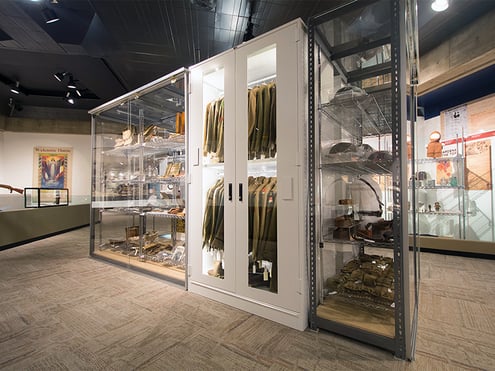
- A Watershield™ cap keeps water from sprinklers, ruptured plumbing, or roof leaks out of the cabinet.
- A closed-cell Elastomeric Seal™ has been verified by a third party to exceed stringent air exchange standards.
Inside, pull-out drawers and racks can be configured to fit the collection, and cabinets can sit on mobile carriages where floor space is tight. The Smithsonian, the Field Museum, and Yale University all use them.
Pro tip: Plan cabinet interiors around sightlines. Shelf heights and drawer placement decide what visitors can see from the aisle.
What Are the Best Visible Storage Systems for Museum Exhibits?
For framed paintings and other hanging works, mobile art racks are the most common choice because they hold works vertically and can be pulled out for viewing. For heavy or oversized objects, open wide-span shelving keeps everything visible and accessible.
Mobile art racks for framed works
Mobile art racks hold framed art on double-sided wire mesh panels that sit flush with the frame, so works can be arranged in nearly any configuration. Floor-mounted systems glide on carriages, and the ceiling-suspended Hang-Glider Pro® pulls out panel by panel, keeping the floor clear. Powder-coated panels and carriages protect artwork from off-gassing.
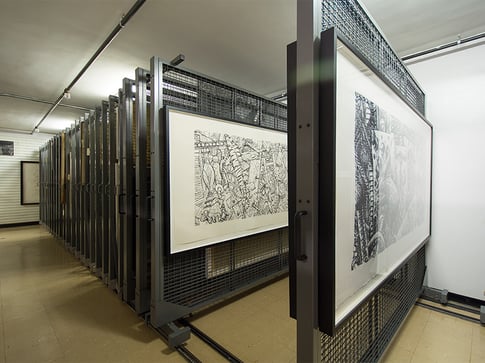
In a visible storage gallery, racks can be pulled out to show a group of works, then rolled back to open the aisle. Mobile systems can also store the same items in half the space.
At the Clark Atlanta University Art Museum, art racks do double duty.
The museum added 16 double-sided racks to the 44 already in its basement storage, where special visitors can now view works from its collection of more than 1,200 pieces of African American and traditional African art that aren’t on view in the 2,500-square-foot gallery. The storage area has become a showpiece for visitors and potential donors.
For more on rack options, see 4 Reasons Your Collection Needs an Art Storage System.
Wide-span shelving for furniture and oversized objects
For furniture, sculpture, and other heavy or oversized objects, wide-span shelving provides sturdy, open shelving that installs or relocates without tools.
Wire decking lets light and air through and allows sprinkler water to reach every shelf, and the full range of Spacesaver powder coat colors makes it easy to match a gallery’s finish.
Pro tip: Leave room in the rack layout for rotation. Visible storage stays interesting when what’s on view changes.
How Do Flat File Cabinets Work for Prints, Maps, and Works on Paper?
Flat files store fragile prints, maps, drawings, posters, and documents flat in shallow drawers, and the right models can double as display furniture.
Flat file cabinets use stainless steel tracks, cushioned drawer bumpers, and safety stops, finished in a non-reactive, solvent-free powder coat designed to meet conservation standards. 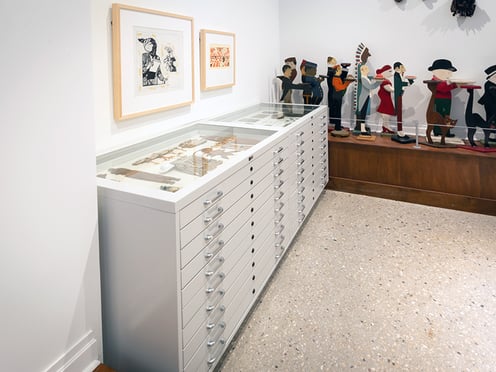
For display, counter-height flat files double as a viewing or work surface. Glass-top models like the Model 414 let visitors look into the top drawer without opening it or touching what’s inside, so works on paper stay protected while they’re on view. Add casters or set them on carts, and flat files can move as the gallery changes.
For more ideas, see Curating Excellence: Museum Storage with Drawing File Cabinets.
Pro tip: Stack flat files to save floor space and keep the most-viewed pieces in the top drawers. Nobody wants to crouch for a Matisse.
What Are the Best Practices for Open Storage Museum Exhibits?
The best open storage exhibits protect the collection first and design for the visitor second. Visible storage still has to do the job of storage, and a few practices keep it working for both:
- Protect first. Use enclosed, sealed cabinets for anything sensitive to dust, humidity, or handling, and save open shelving for durable objects.
- Control light. Light damage is cumulative, and objects in visible storage are exposed every day. Plan light levels and glazing with your conservator.
- Make the organization part of the display. Group objects logically, and label them clearly enough for visitors and staff alike.
- Plan sightlines and aisles. Set shelf and drawer heights so visitors can see what’s stored, and keep aisles wide enough for groups and visitors using wheelchairs.
- Decide how visitors get access. Choose what stays view-only, what’s available on guided tours, and what can be seen by appointment.
- Secure it. Locking cabinets and drawers keep objects safe in a public space, including from visitors who want a closer look.
- Build in flexibility. Adjustable shelving and mobile units make it easier to rotate what’s on view and make room for new acquisitions.
- Choose conservation-safe materials. Powder-coated steel helps protect objects from off-gassing.
For more on balancing access and preservation, see Museum Collections Storage: Maximizing Space and Accessibility.
Bring Your Collection Into View
Museum visible storage works when the equipment protects the collection and shows it off at the same time. The real decision is which objects can safely be on view, and which storage will keep them visible without exposing them to more risk.
Patterson Pope designs, supplies, and installs Spacesaver museum storage, from museum display cabinets and art racks to flat files and wide-span shelving, along with space planning and long-term service.
So, is your museum storage visible? If your answer is “only to the staff,” start by visiting our museum storage page for more information, or talk to a Patterson Pope specialist to start planning.