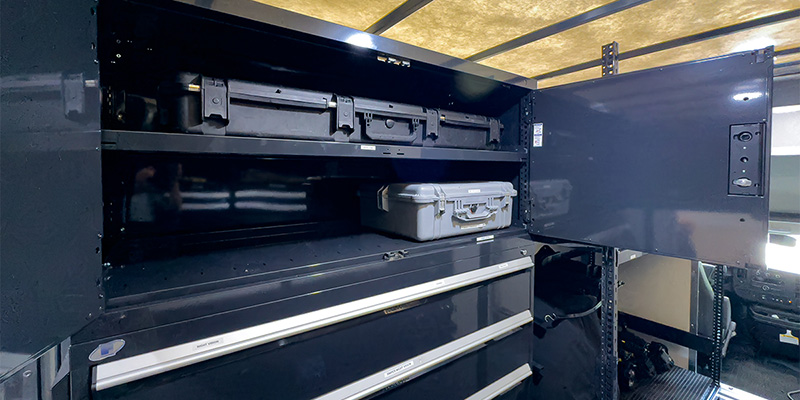
Law enforcement officers can count on one thing every day: unpredictability. When no two calls are the same, having predictable law enforcement vehicle storage can make a real difference. Patrol cars, SWAT trucks, CSI vans, and command units all benefit from modular storage that supports consistent, fast, and accountable access to critical gear.
Many public safety vehicles serve as more than transportation. They're also mobile workspaces, each with its own demands:
- Patrol vehicles store and secure duty weapons, ammunition, and daily-use equipment.
- SWAT trucks carry body armor, helmets, gas masks, breaching tools, and other tactical gear.
- CSI vans support evidence collection with bags, kits, cameras, and field equipment.
- Mobile command units house communications and IT systems, drones, incident documentation, whiteboards, first-aid supplies, and personal protective equipment.

Every item is mission-critical. So, when vehicle storage is disorganized or inconsistent, teams lose time they don’t have. Well-designed law enforcement vehicle storage brings order to that complexity, using predictable, labeled, and modular layouts that support consistency, accountability, and speed when it matters most.
Law Enforcement Vehicle Storage Challenges
Gear spread across trunks, piled into trailers, or stacked in corners can cost valuable time during an emergency. Without a consistent system, how equipment is stored can vary from shift to shift, vehicle to vehicle, and team to team.
That kind of disorganization causes real problems. Officers may not know where items are supposed to live, making it difficult to retrieve gear quickly or even tell when something is missing. Clutter can also add unnecessary stress in already high-pressure situations, undermining focus when clarity matters most.
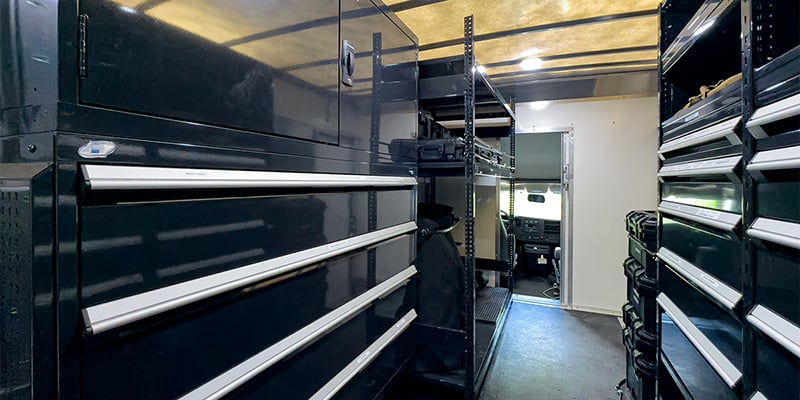
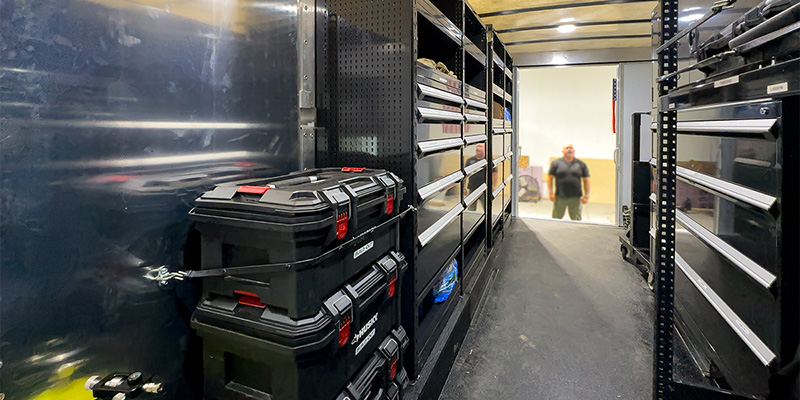
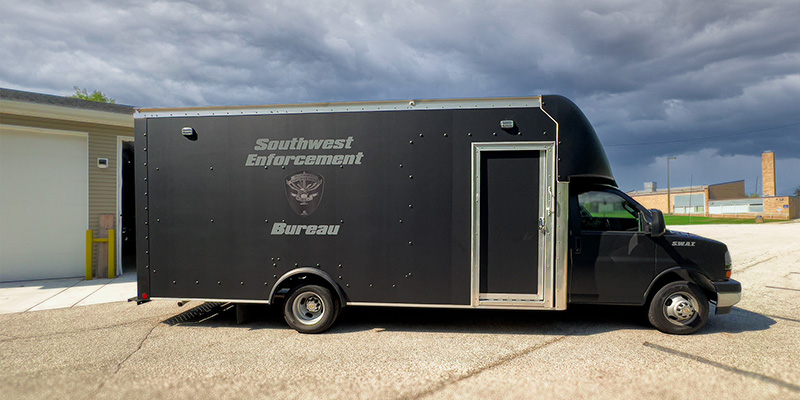
For the Southwest Enforcement Bureau (SEB), a multi-city tactical task force serving communities south of Cleveland, Ohio, equipment sprawl had become a liability. “When it comes to SWAT situations, they are emergencies where seconds count,” said Lt. Mike Dulin, SEB Unit Commander. “Finding the equipment that you need as quickly as possible and getting it out to the troops to get the mission going is absolutely necessary.”
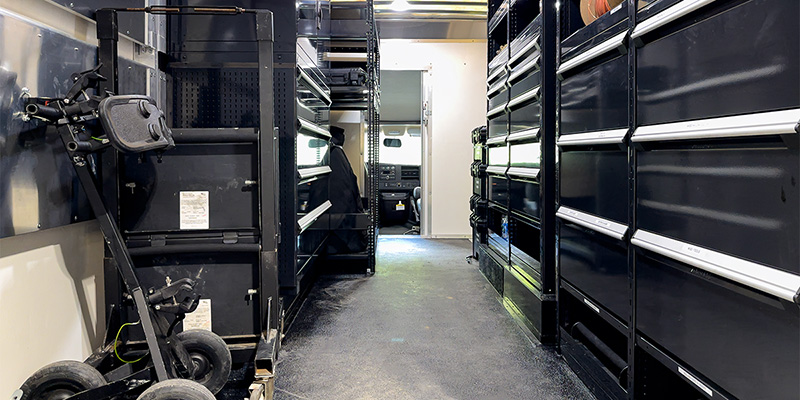
SEB needed to consolidate three SWAT teams’ worth of gear into a single, centralized truck. Lt. Dulin wanted every item organized, labeled, and easy to access. The solution also had to withstand constant vehicle movement, vibration, and a wide range of field conditions.
By partnering with Patterson Pope, SEB implemented public safety vehicle storage that secured high-value and sensitive equipment while still supporting different, often urgent, loadouts. Everything fit within the footprint of a single vehicle, requiring thoughtful use of both vertical and horizontal space to keep the truck organized, flexible, and ready to deploy.
Storage Solutions Boost Mobile Mission Readiness
Mobile readiness starts with storage that’s built for the realities of law enforcement vehicles. Systems need to handle tight footprints, constant movement, and sensitive equipment, while still supporting accountability and fast access under pressure.
Different storage solutions address these challenges in different ways. The sections below break down the core product families used in law enforcement vehicle storage, using the Southwest Enforcement Bureau’s equipment truck revamp as a real-world example.
Modular Drawer Cabinets: Built for Mobile Operations
Modular drawer cabinets are often the backbone of emergency vehicle storage. They turn limited, mobile space into organized, secure storage that holds up under constant movement and high-stakes use.
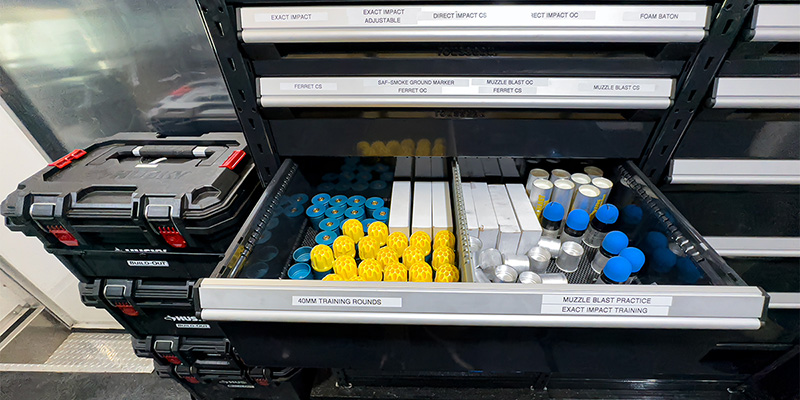
Standardized drawer layouts help keep gear from shifting during transport and provide a dedicated place for everything from optics and medical supplies to tools and electronics. Lockable drawers add another layer of protection, securing high-value equipment and supporting chain-of-custody requirements without slowing access.

Because these systems are modular, they adapt easily across missions and vehicle types. Labeled, compartmentalized drawers improve accessibility while making it immediately clear when something is missing, an important advantage when teams rotate between shifts or vehicles.
Built to withstand vibration, heat, moisture, and heavy loads, modular drawer cabinets also help reduce wear over time while making better use of available space inside the vehicle.
For the Southwest Enforcement Bureau, adopting the modular drawer cabinets improved both inventory management and response time. As Lt. Mike Dulin explained, “With the cabinetry that we have in the equipment truck now, we can get in, grab what we need, and go. We can also tell if something’s missing because it’s not in the drawer where it’s supposed to be.”
Safeguarding Sensitive Equipment on the Move
Effective vehicle storage needs to secure specialized equipment without slowing access in the field. SWAT trucks and patrol vehicles may carry entry weapons, sniper scopes, shields, and less-lethal launchers — items that must remain controlled at all times. Firearms and other sensitive equipment need to stay secure not only during transport, but also when vehicles are parked or unattended.

Lockable storage plays a key role here. Features like biometric keypads on modular gun safes can help departments meet internal policies for weapon security and accountability while still allowing authorized users to access equipment quickly when needed.
Well-designed law enforcement vehicle storage also supports safe deployment under pressure. Locked compartments and purpose-built layouts help prevent shifting, impact damage, or accidental discharge while the vehicle is in motion. Solutions such as mini-universal weapons racks and modular gun safes make use of otherwise wasted space, keeping sensitive gear organized, protected, and ready.

Configuring a system for the different vehicle type, weapon platform, or mission profile is easier with modular storage purpose-built to prevent shifting, impact damage, or accidental discharge while the vehicle is in motion.
Putting Pelican Cases in Their Own Place
Law enforcement teams often rely on heavy-duty Pelican cases to transport robotics, drones, fiber optics, and other sensitive electronic tools. These cases do their job protecting equipment, often with custom foam inserts sized for specific devices. But when multiple cases are stacked or piled together inside a vehicle, finding the right one can slow response when time matters most.
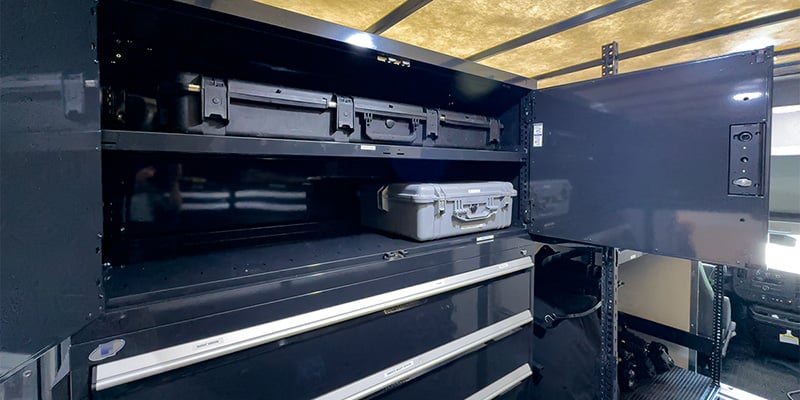
The Southwest Enforcement Bureau wanted every Pelican case to have a defined space inside its SWAT truck. By integrating shelving with drawers to accommodate Pelican or larger robotics cases, the team eliminated wasted motion during deployment.
“No more wasted minutes,” Lt. Dulin said. “Operators can move and pack faster. Locked storage keeps high-security items in check, and even the robot has its own place.”
What to Consider When Outfitting Your Next Police or SWAT Vehicle
When planning law enforcement vehicle storage for a patrol car, SWAT truck, or specialized unit, a simple checklist can help teams think through real-world demands before equipment ever goes inside the vehicle.
Inventory:
- What gear needs to live in the vehicle versus at headquarters?
- How often is each item used?
- What missions or response types rely on specific equipment?
- What items are consumed or replaced regularly and need easy replenishment?
Accessibility:
- Who needs access to each item in the vehicle?
- In what order should gear be retrieved during rapid deployment?
- Where can ergonomic placement reduce reach, bending, or wasted motion?
Security:
- Which items require locks, double-locks, or physical separation?
- What storage supports agency policies for the chain of custody?
- How is access controlled, monitored, or logged for accountability?
Scalability:
- How can labeling, color coding, or numbering support future growth?
- Will the loadout expand as equipment or missions evolve?
- Can the storage system adapt without a full vehicle rebuild?
- Have weight distribution and space utilization been considered to maintain vehicle safety?
Storage to Serve the Mission
Law enforcement vehicle storage is about making space, but it also plays a direct role in speed, safety, and accountability. The right layout helps law enforcement teams stay organized under pressure, retrieve equipment quickly, and operate with confidence when every second counts.
Patterson Pope works with public safety departments to design vehicle storage layouts that support real-world missions. By focusing on predictable access, secure storage, and adaptable configurations, our team helps agencies build custom vehicle interiors that are ready for today’s demands and flexible enough for what comes next.