Warehouse layout design shapes how a warehouse works: how easily inventory is accessed, how efficiently space is used, and how well the operation can adapt as needs change.
This practical guide walks through the core factors that influence racking layout decisions and introduces a clear framework for choosing a layout that supports both day-to-day operations and long-term growth.
What is a Warehouse Racking Layout?
A warehouse racking layout is the planned arrangement of storage racks, aisles, and work zones that determine how products are stored, accessed, and moved through a facility safely and efficiently.

But layout is about more than deciding where racks go. A well-planned racking layout defines how a warehouse operates. It influences inventory movement, equipment paths, safety conditions, and how easily the space can scale over time. Every layout decision has a direct impact on productivity today and costs tomorrow.
In short, a warehouse racking layout is the blueprint that governs how inventory flows through the warehouse.
Why Warehouse Racking Layouts Matter More Than the Racks Themselves
Warehouse layout design decisions shape how efficiently a warehouse operates because they directly address the everyday challenges facilities face as inventory, equipment, and workflows evolve.
A well-designed warehouse racking layout helps optimize:
- Space utilization: Thoughtful aisle spacing, rack height, and use of available cubic space allow warehouses to store more inventory without giving up valuable floor area to unnecessary aisles.
- Forklift movement: Layout planning reduces congestion by defining clear travel paths and accounting for forklift turning radius and traffic patterns. Better flow improves both operating speed and worker safety.
- Access speed: Adding more racks doesn't automatically improve performance. Strategic placement of fast-moving inventory, shorter travel distances, effective use of vertical space, and alignment with warehouse workflows all influence how quickly items can be accessed and picked.
- Long-term flexibility: Layouts that aren't planned for change often lead to inefficiency and costly retrofits. Designing a racking layout with future growth in mind makes it easier to accommodate SKU changes, new equipment, or automation without starting over.
Why a Racking Layout is More Than "Where Racks Go"
A good racking layout does more than fill open space or assume that adding more racks will solve storage challenges. Effective warehouse layout design balances storage density, movement, safety, and scalability to support how the operation really runs.
Because every layout decision affects how people, forklifts, and goods interact, planning must account for:
- How products arrive at the warehouse and are shipped out
- How frequently items are picked or accessed
- What material handling equipment is used, such as forklifts, reach trucks, or pallet jacks
- Required safety clearances and regulatory considerations
- How the business and inventory mix may change over time
In other words, an effective racking layout functions as an operating system for the facility, instead of just a floor plan.
Key Factors That Drive Warehouse Racking Layouts
Warehouse layout design determines how much inventory fits within a facility and how people, products, and equipment interact every day. The most effective layouts are built around five core factors.
Inventory Profile
Inventory characteristics play a major role in shaping aisle structure, storage density, and rack selection.
- SKU variety vs. uniformity: A wide range of SKUs typically requires greater selectivity and more direct access to individual pallets or items.
- Pallet sizes and weights: These factors influence rack design, spacing, and overall layout geometry.
- Turnover speed: How often your inventory moves affects where items are positioned within the layout.
Access Requirements
Access expectations directly influence aisle count and layout planning.
- Direct access: Requires more aisle space but improves access speed and operational flexibility.
- Limited access: Increases storage density but reduces flexibility and may limit equipment options.
- Trade-offs: Access decisions should align with operational priorities rather than default assumptions.
Material Handling Equipment
Racking layout should be planned around the equipment used to move inventory.
- Standard forklifts: Require wider aisles and racking designed to withstand impact.
- Narrow-aisle equipment: Allows for higher density but can reduce layout flexibility.
- Travel paths: Fewer turns can reduce accident risk and equipment wear.
- Cross-aisles: Proper placement helps prevent congestion and improves flow.
Growth & Change Over Time
Layout decisions affect how easily a warehouse can adapt as needs evolve.
- Inventory growth and SKU changes: Modular rack systems support reconfiguration over time.
- Long-term flexibility: Planning for change reduces future reconfiguration costs.
- Future-proofing: Extra clearance and aisle access built in early can protect long-term racking ROI.
Common Warehouse Racking Layout Strategies (and When They Make Sense)
Strategy 1: Direct-Access Layouts for High SKU Variety
Best for: High SKU variety, frequent access, and changing inventory
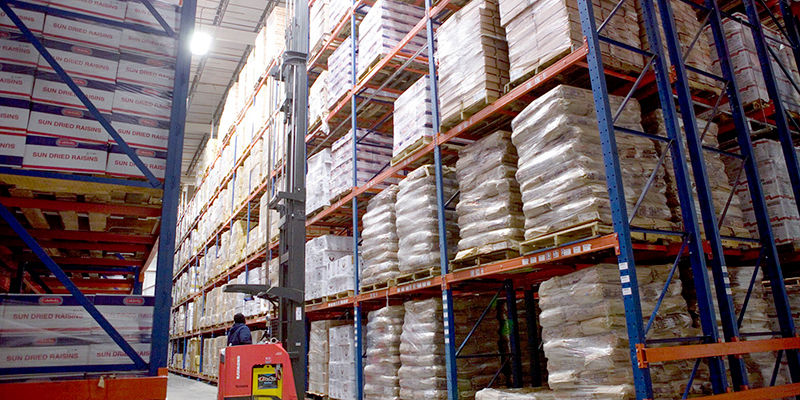
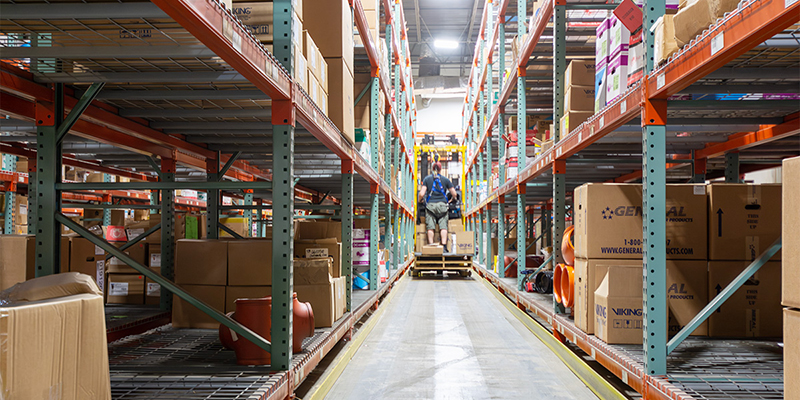
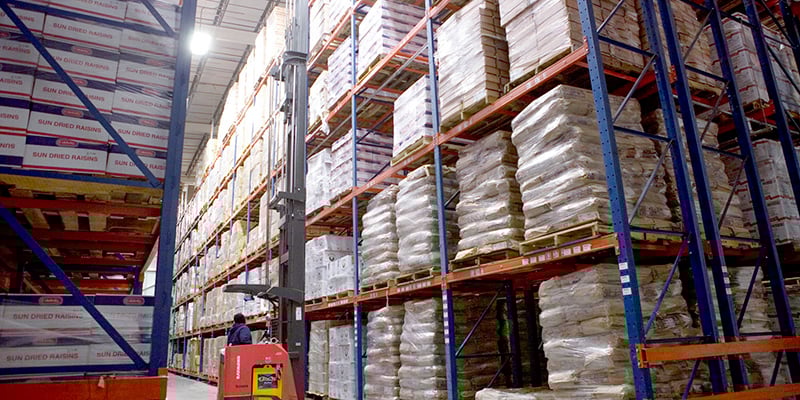
Some warehouses prioritize direct access to every pallet over maximum storage density. In these layouts, aisle space is intentionally preserved to support fast picking, easy inventory management, and operational flexibility.
Layout considerations:
- More aisles are required to allow direct access to every pallet
- Maximum selectivity across SKUs supports frequent access and change
- Larger footprints are common compared to denser layout strategies
This strategy is often the starting point for warehouses with diverse or frequently changing inventory. As volume grows, aisle space can become a limiting factor, prompting a shift toward denser layout strategies.
Common supporting system: Selective pallet racking
Strategy 2: High-Density Layouts for Uniform Inventory
Best for: High volumes of similar SKUs and density-focused storage
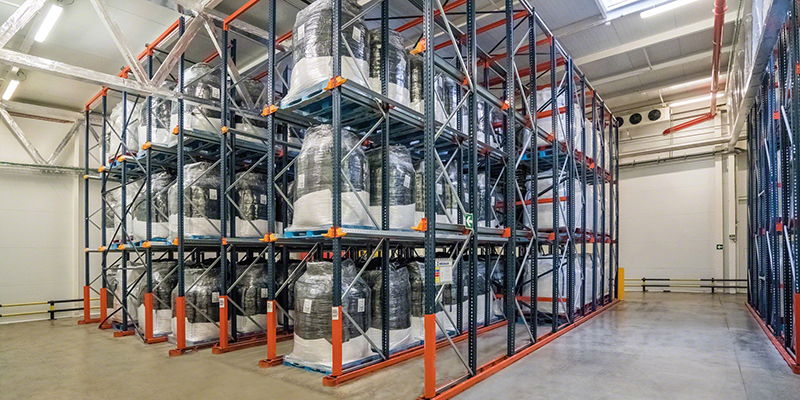
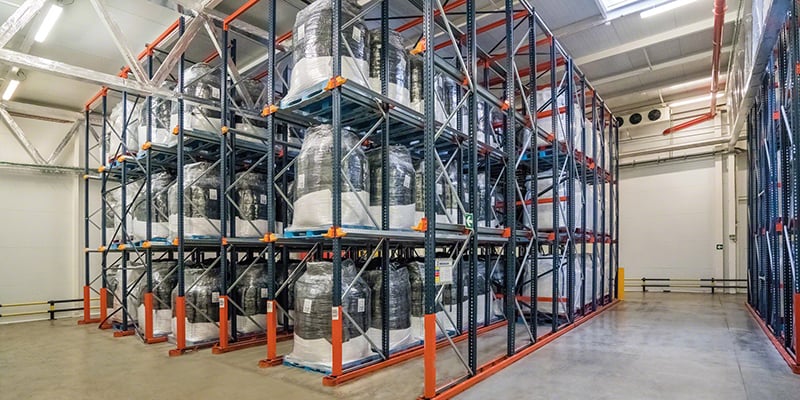
When maximizing capacity within a fixed footprint is the top priority, high-density layouts reduce aisle count by storing pallets multiple positions deep within rack structures. Density is achieved by limiting access lanes, not eliminating them.
Layout considerations:
- Fewer aisles increase cubic storage utilization by dedicating more floor space to rack runs
- Forklift traffic must be carefully planned within fixed rack lanes, including entry and exit points
- Adequate staging space is required at lane entrances for safe loading and retrieval
- Access trade-offs must align with inventory uniformity and predictable stock rotation
Common supporting systems: Drive-in and drive-thru racking
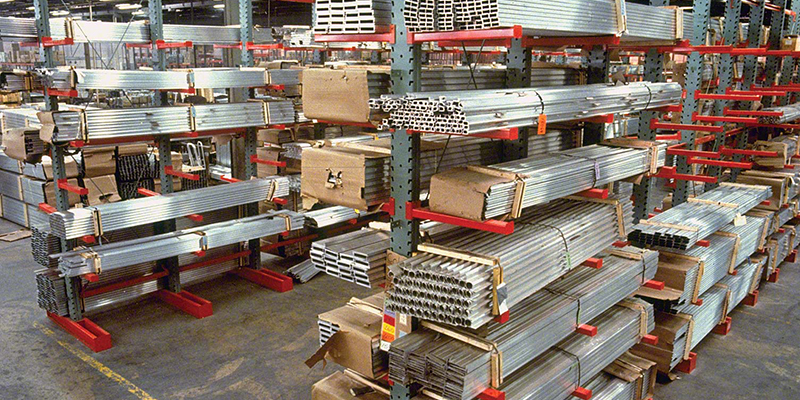
Strategy 3: Layouts for Long, Bulky, or Irregular Materials
Best for: Oversized materials that don't fit standard pallets
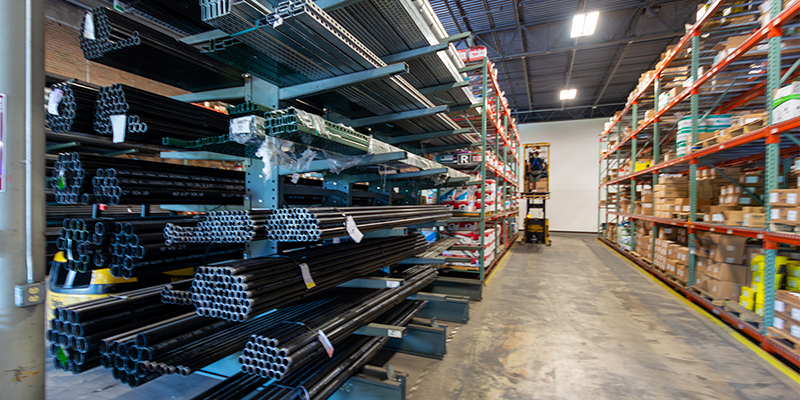
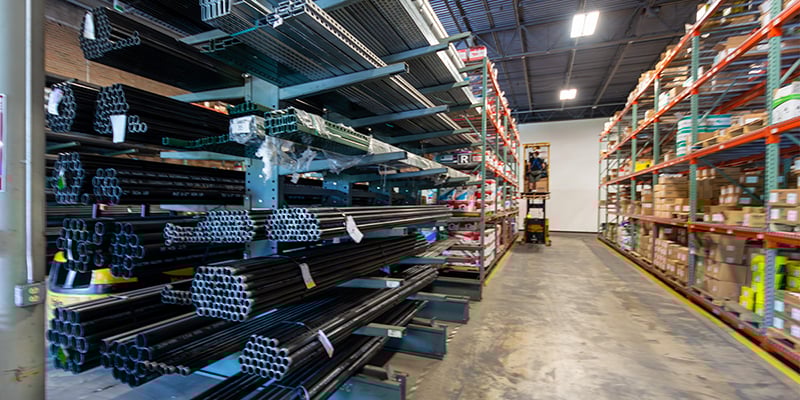
Some warehouses need layouts designed around the physical characteristics of the product rather than pallet dimensions. These layouts prioritize clear access paths, safe handling, and flexible storage lengths.
Layout considerations:
- Wider aisle spacing to support safe handling of long loads
- Clear access paths to allow smooth loading and unloading
- Indoor layouts: Emphasize clearance, visibility, and traffic flow
- Outdoor layouts: Account for weather exposure, surface conditions, and equipment access
Real-World Example: A growing fire protection and fabrication company, Viking SupplyNet, used cantilever racking to store long pipes while maximizing available warehouse square footage as part of a broader facility layout strategy.
Common supporting systems: Cantilever racking
Strategy 4: Space-Optimized Layouts for Constrained Facilities
Best for: Space-constrained warehouses or retrofit projects
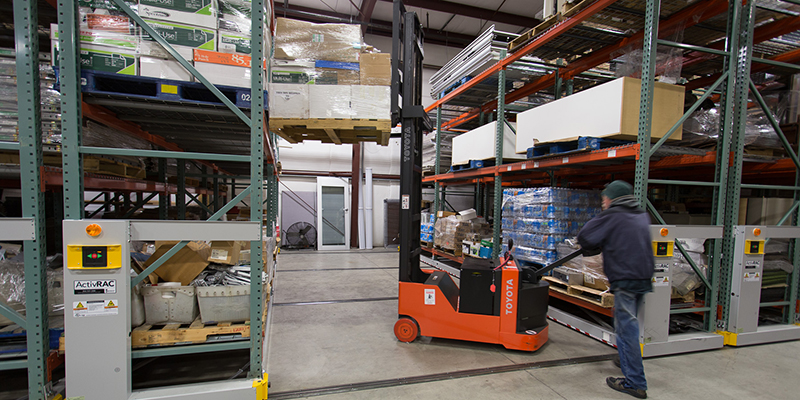
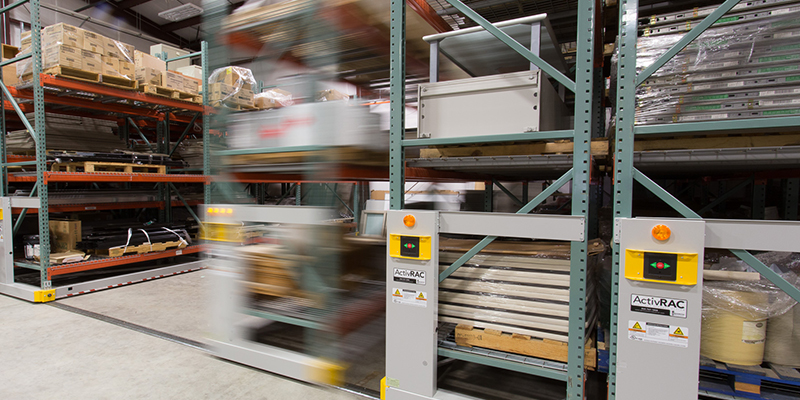
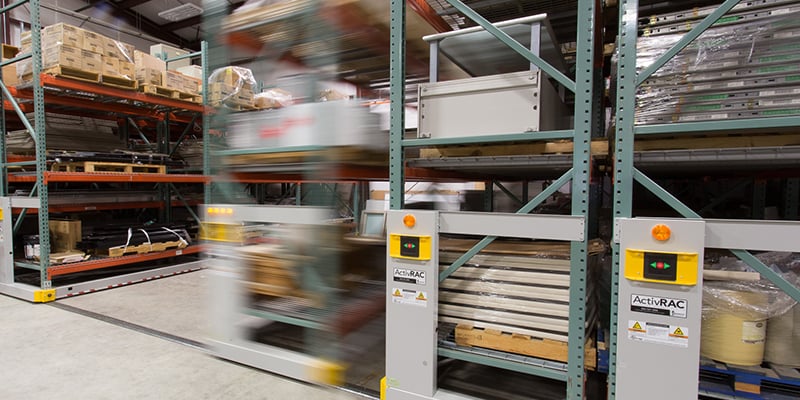
When floor space is limited, the challenge is finding ways to increase storage capacity without adding square footage. In these cases, the best layout may eliminate fixed aisles altogether, opening access only where it's needed.
Layout considerations:
- Active aisles instead of multiple fixed aisles can reduce the racking footprint by up to 50 percent
- Eliminating fixed aisles helps recapture high-value floor space
- Makes better use of limited building square footage with mechanical or electric assist mobile systems
- Supports future growth without building expansion, and works well in retrofit projects
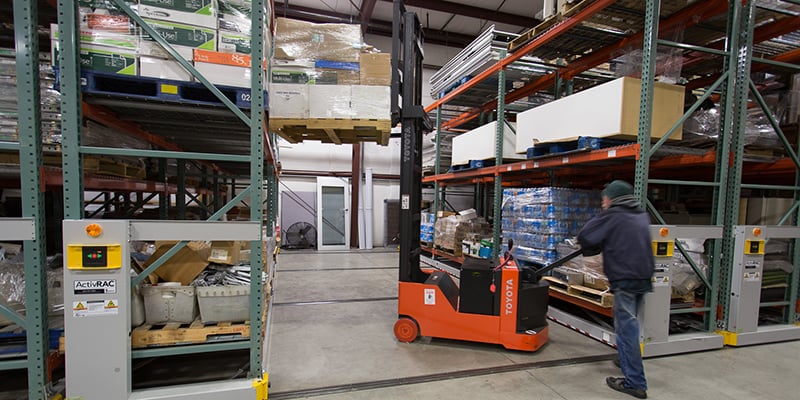
This strategy allows warehouses to increase capacity without expanding their footprint and works well for both new facilities and retrofits.
Real-world example: Headrest manufacturer VOXXHirschmann used a mobile pallet racking layout to increase storage capacity within a new facility footprint.
Common supporting systems: Mobile pallet racking systems, such as ActivRAC
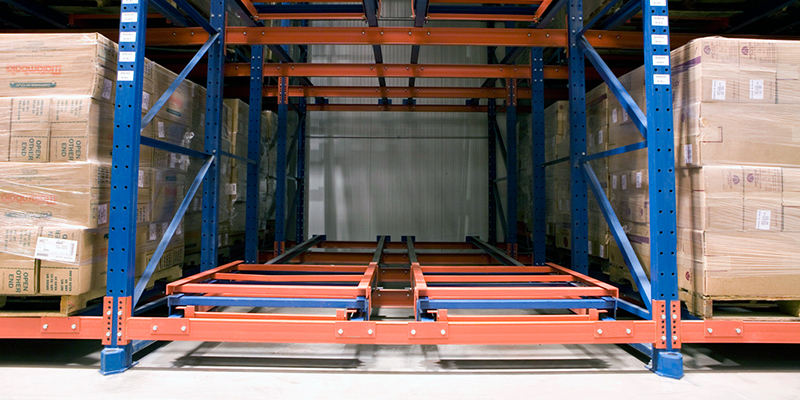
Strategy 5: Hybrid Density Layouts for Narrow SKU Profiles
Best for: Moderate density needs with limited SKU variation
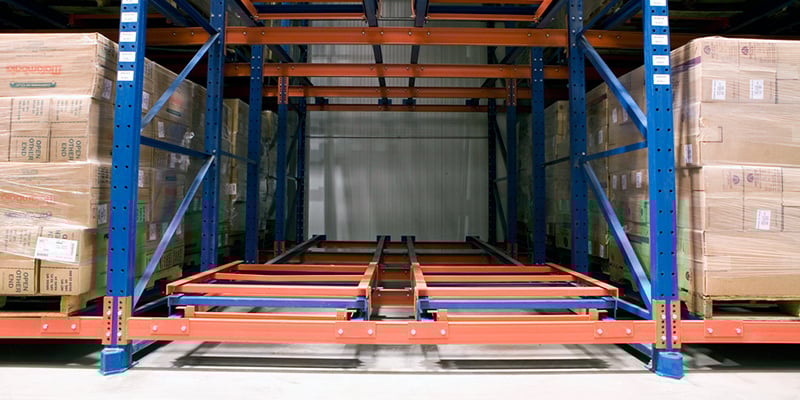
Some warehouses need more storage density than direct-access layouts provide, but don't require the depth or restrictions of full high-density systems. Hybrid density layouts sit between those extremes, offering improved capacity while maintaining controlled access.
Layout considerations:
- All pallets are accessed from the front of the rack
- Pallets stored deeper in the lane are not directly accessible
- SKU mixing within a single lane is limited
- Fewer aisles are required compared to direct-access layouts
These layouts work best for consistent inventory profiles with predictable pallet depths. They can increase capacity without the complexity of deeper storage strategies, but they are less flexible for frequent picking or rapid SKU changes.
Common supporting system: Push-back racking
How to Choose the Right Warehouse Racking Layout
Choosing the right warehouse racking layout works best when decisions follow a structured process rather than assumptions. The framework below helps align layout choices with operational priorities.
Step-By-Step Layout Decision Framework
Step 1: Define Access Needs
Start by determining how often individual pallets or items must be accessed. Operations that require frequent access typically benefit from higher selectivity and additional aisles, while lower access requirements may allow for denser layouts.
Step 2: Identify the Primary Constraint
Every warehouse is limited by something. Identifying the dominant constraint helps narrow layout options early. Common constraints include:
- Limited floor space
- Required access speed
- Long, bulky, or irregular loads
- Uncertainty around future growth
Keeping these constraints in focus helps balance immediate needs with long-term considerations.
Step 3: Understand the Inventory Profile
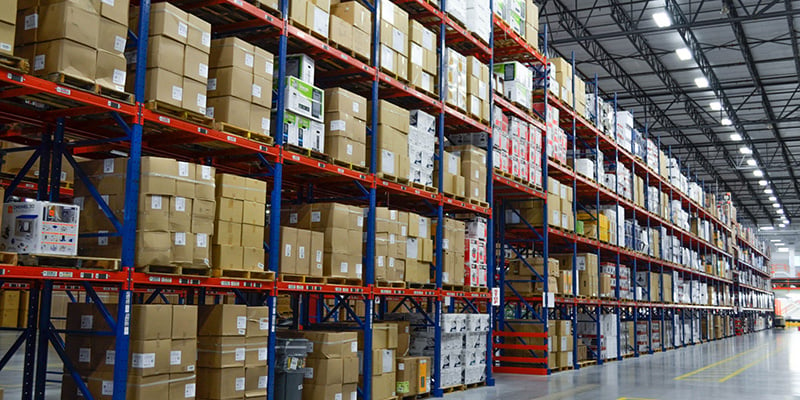
Inventory characteristics should drive layout decisions. Evaluate SKU variety, pallet size, weight, and turnover patterns before selecting a layout strategy.
Step 4: Plan for Growth from Day One
Inventory and operations will change. Building flexibility into the layout makes it easier to accommodate SKU growth, volume increases, or new equipment without major disruption.
Using this framework to compare access, density, flexibility, and growth readiness helps narrow layout options. The goal isn't perfection but choosing a layout that aligns with operational priorities today while remaining adaptable for tomorrow.
Final Thoughts
A strong warehouse layout design is the foundation of efficient storage and material movement. When designed well, it improves space utilization, speeds daily operations, enhances safety, and keeps the warehouse adaptable as business needs evolve.
Effective layout decisions should be guided by priorities, trade-offs, and long-term operational goals. The right warehouse racking layout balances today's constraints with tomorrow's uncertainty. Rather than searching for a single "best" racking system, use a structured decision framework to identify the layout that delivers the right advantages for your operation.
If you're evaluating layout options or planning for future growth, Patterson Pope's storage consultants can help. Our team works with warehouse leaders to assess constraints, compare layout strategies, and design solutions that support both immediate needs and long-term flexibility.