
Setting up storage in a new pharma lab is not just a question of where the extra supplies go.
It’s a planning decision that affects how safely, cleanly, and efficiently the lab operates. Some items need visibility. Some need security. Some need environmental control. Some belong near the point of use, while others should stay in backstock or support areas.
That’s why pharma lab storage works best when it follows a clear sequence: identify what needs to be stored, define the control requirements, match the right storage system to the need, and make sure the layout supports daily workflow as the lab changes over time.
This guide walks through that planning process, with practical considerations for lab equipment storage and space-saving systems that support the realities of a new lab buildout.
Start with what the lab needs to store
The first step in planning pharma lab storage is to take inventory and ask a simple question: What are we storing?
Just because materials share the same lab doesn’t mean they should share the same storage strategy. A new lab typically needs to account for several distinct categories, each with its own access, handling, and control requirements:
- Drugs and controlled materials need to be identified early because their access, security, and documentation needs may shape the storage plan.
- Chemicals and hazardous materials bring storage considerations tied to hazard class, compatibility, quantity, and SDS requirements.
- Consumables and everyday supplies are high-frequency items that need to be visible, easy to retrieve, and simple to restock.
- Instruments, benchtop tools, and larger shared equipment need to be stored near the work they support, without turning the bench into the default storage zone.
- Reference materials and standards may come with specific storage instructions tied to the supplier label, certificate, or internal SOP.
- Samples, retained materials, and temperature-sensitive items may require consistent conditions, controlled placement, or monitoring based on how they are used and retained.
Identify what needs protection, control, or special conditions
Once you know what the lab needs to store, the next step is understanding what each category requires. In pharma lab storage, the wrong storage plan can affect safety, compliance, contamination control, and retrieval speed.
A few questions can help determine how each item or material category should be stored:
Does it need segregation?
Certain chemicals should be separated and stored by hazard category and compatibility, with SDS and label information guiding storage requirements. Some drug classes, controlled materials, or retained materials may also need a dedicated location away from general inventory.
Does it need enclosure or secured access?
Controlled substances, high-value materials, selected reagents, and sensitive records may require locked, access-controlled, or staff-managed storage instead of open access.
Does it require temperature or environmental control?
Samples, retained materials, reference standards, certain reagents, and temperature-sensitive compounds may need consistent conditions, monitoring, or protection from heat, humidity, light, or other environmental factors.
Should it stay near the point of use?
Frequently accessed consumables, instruments, and supporting supplies lose efficiency when they’re stored somewhere that adds steps to every task. The more often something is used, the more carefully its location should be planned.
Does it belong in support storage instead of active lab space?
Backstock, retained samples, overflow consumables, and infrequently used equipment may not need to occupy the primary lab footprint. Moving those items into support storage can help preserve active lab space for the work itself.
Answering these questions before choosing a storage system helps prevent a common new-lab mistake: buying general-purpose storage only to discover it doesn’t support the controls, access, or workflow the lab actually needs.
Choose lab storage systems based on access, control, and use
Once the lab’s requirements are clear, the storage choices get more straightforward. Different lab equipment storage systems solve different problems, and the goal is to match each material category to the level of access, control, visibility, and support it actually needs.
For point-of-use access
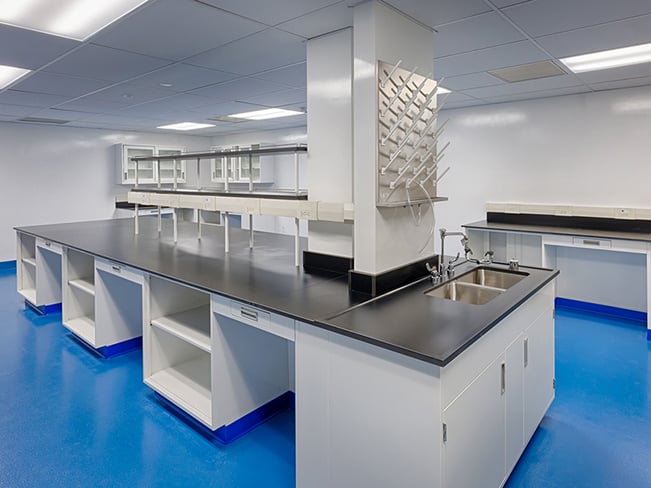
When materials need to stay close to the work, modular casework can bring storage directly into the workstation. Drawers, cabinets, shelving, and integrated work surfaces help keep instruments, benchtop tools, and supporting supplies near the task without crowding the bench.
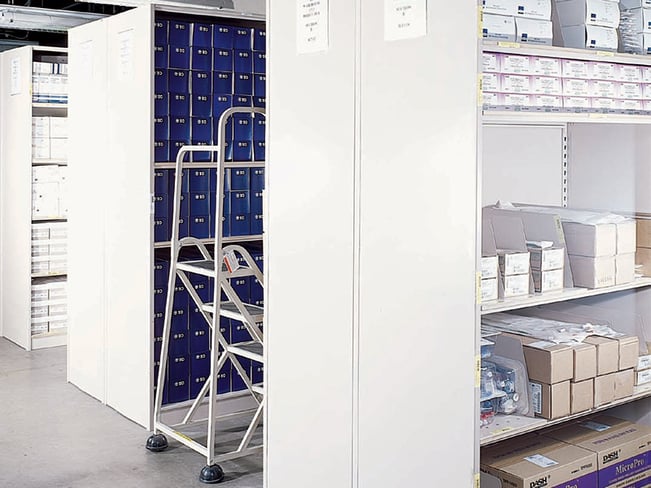
Static shelving can also support everyday lab storage when visibility matters. For general supplies, bins, boxed materials, and frequently used consumables, open shelving makes it easier for staff to see what is available, retrieve what they need, and restock without adding unnecessary complexity.
For enclosed or protected storage
Some materials need more separation than an open shelf can provide. In those cases, cabinets or enclosed storage can help create a clearer line between general-access supplies and materials that need to be protected, organized, or kept out of the main inventory flow.
This can be especially useful for certain drugs, controlled materials, high-value items, sensitive supplies, or materials that need staff oversight. Locking storage can add physical security, but broader accountability still depends on how access, documentation, and handling procedures are managed around the storage.
For dense, support storage
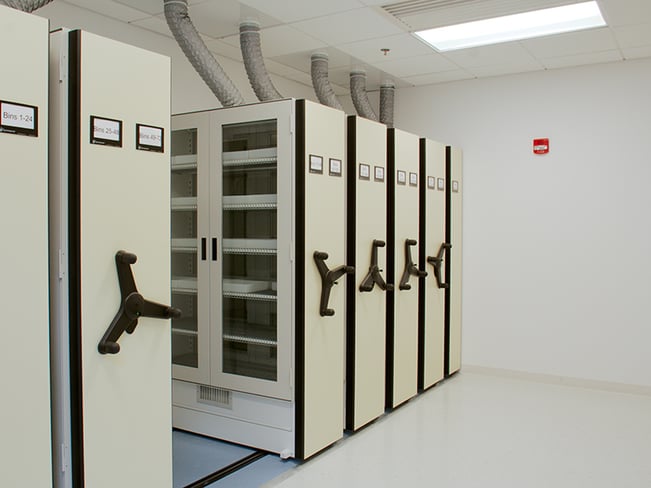
High-density mobile storage can be a strong fit for support spaces, supply rooms, retained materials, or backstock areas where the lab needs more capacity without expanding the room. By reducing the number of fixed aisles, these systems can help keep materials nearby without giving storage more floor space than it needs.
The key is placement. High-density mobile storage works best where access can be planned around the workflow. In active lab zones where staff need constant, simultaneous access to materials, that same density may create delays if people are waiting on a single open aisle mid-task.
For compact, vertical storage
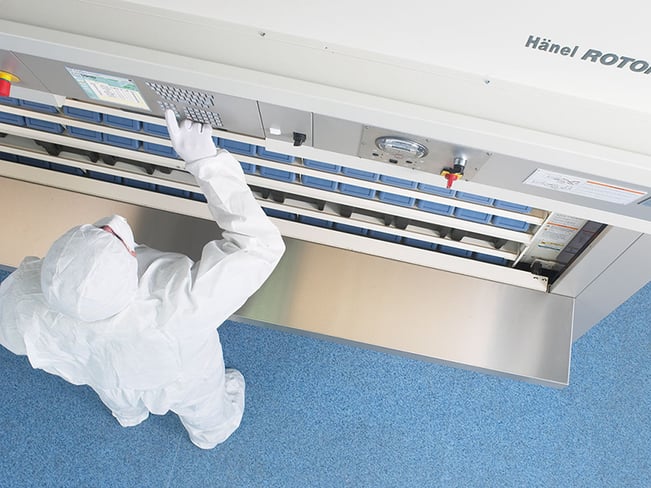
Lifts and carousels are not a fit for every lab, but they can be useful in facilities with tight footprints, expensive real estate, or selected materials that benefit from dense vertical storage. By using height instead of floor space, these systems can free up square footage for bench work, equipment, or circulation.
They tend to make the most sense for smaller items and packaged supplies, rather than bulky equipment or broad-access storage.
Plan storage around daily lab workflow
Storage that looks organized on a floor plan can still slow a lab down if it doesn't account for how materials move through the space. The real test is whether the placement supports the work.
Think through the full material lifecycle: how items are received, where they're stocked, how staff retrieve them during active work, how replenishment happens without disrupting that work, and what documentation each step requires. A storage system that creates a detour every time someone needs a frequently used item costs time, every single day.
The goal is not just to store materials neatly. It’s to place them where they support the pace, sequence, and control requirements of the work.
Build flexibility into the lab from day one
A new pharma lab is rarely static for long. Inventory levels shift, test methods change, new equipment arrives, and protocols get updated. The storage plan that works on opening day can be quickly outgrown if it was only built for opening day.
That’s why flexibility matters. Modular casework can be reconfigured as workstations change. Cabinets can be reassigned as material categories shift. Shelving and support storage can be planned with room to adjust, expand, or move into adjacent space without forcing a redesign of the active lab.
Shelving, high-density mobile systems, and more specialized options like vertical lifts also hold up better over time when future growth is part of the original plan.
Storage planned with room to adapt can absorb change instead of being undone by it. Choose systems that can flex so the storage plan continues to support the lab as the work evolves.
Storage planning is lab planning
The best pharma lab storage plans start with the work. What needs to be stored? What requires control? What belongs near the bench? What should stay in the support space? And what needs to change as the lab grows?
Answer those questions early, and the storage systems that follow tend to make a lot more sense. If you’re setting up a new pharma lab, Patterson Pope can help you plan storage around what you store, how your team works, and where the lab needs to go next.