
Storing sterile instruments isn’t one decision; it’s several. A sterile processing department handles fast-turnover kits and slow-moving overflow stock in the same room, and no single system is built to do both jobs well.
Best practice isn’t a universal setup. It’s matching each type of inventory to the solution built for it, then checking that match against how the department runs day to day. Here are five real sterile storage solutions, what each one is actually built for, and how it lines up with the practices that keep a sterile core running.
Open Static Shelving Keeps Fast-Turnover Stock Moving
Why it works: Nothing stands between staff and the shelf, so a pull takes seconds and stock stays visible for a quick inventory check without opening a single door. For kits that move multiple times a shift, that speed is the whole point.
Best for: Daily-use kits, high-turnover supplies, and budget-conscious buildouts where visibility matters more than enclosure.
Pro tip: Open sterile storage shelves only protect sterility if labeling and rotation discipline are doing the actual work. There’s no door slowing anyone down long enough to double-check, so that discipline has to be built into how the shelf is organized, not left to memory.
Glass-Door Modular Casework Protects Slower-Moving Stock
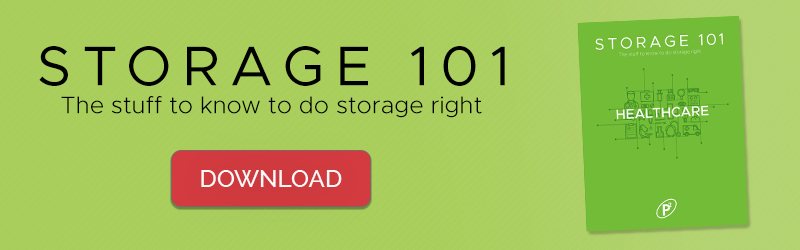
Why it works: Enclosed, glass-door stainless steel modular casework keeps dust and room air off packaging while the door is closed, protecting slower-moving kits without giving up visibility entirely. The tradeoff is a few extra seconds per retrieval, which barely registers for stock that isn’t pulled constantly.
Best for: Anything that sits on the shelf longer between pulls, and any kit where a compromised wrap means a costly trip back for re-sterilization.
Pro tip: Look for medical-grade sterile storage cabinet options certified to SEFA-8 metal casework standards. That certification tests chemical resistance, load capacity, and door durability directly, rather than asking you to take a cabinet’s durability on faith.
However, not every cart in the room needs that certification. Reserve it for anything that comes in direct contact with sterile stock.
High-Density Mobile Shelving Reclaims Floor Space
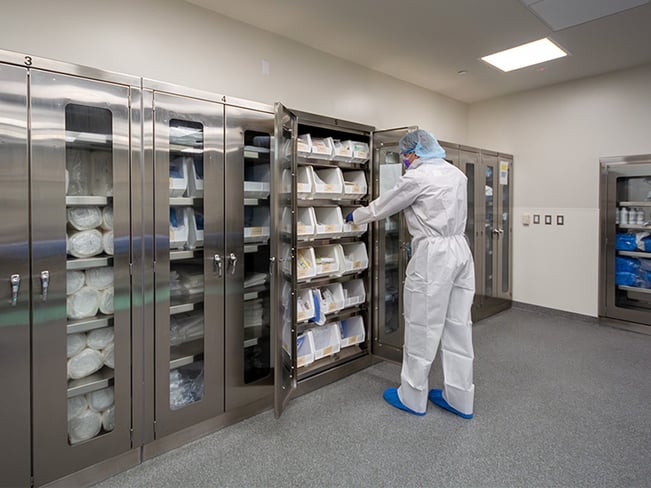
Why it works: High-density mobile shelving rides on sliding rails, removing fixed aisles so a room can hold significantly more storage without adding square footage. It’s a way to gain capacity in an existing footprint instead of pushing into a full renovation.
Best for: Growing sterile processing departments that are out of room but not out of budget for a full addition, and slower-moving overflow stock that doesn’t need constant access from multiple staff at once.
Pro tip: Reserve high-density for stock that isn’t being pulled every few minutes. A single working aisle can become a bottleneck during a busy shift if the wrong inventory ends up there.
A Vertical Carousel Adds Density and Handles Rotation on Its Own
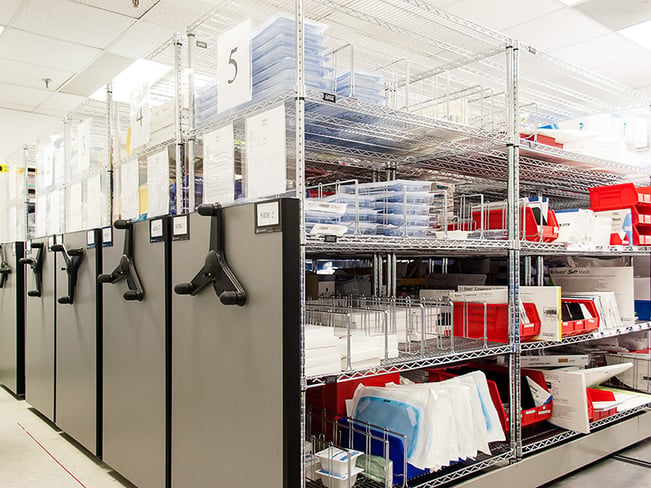
Why it works: A carousel like the Hänel Rotomat brings inventory to the operator instead of the other way around, adding real storage density without adding floor space, and tracking what’s stored and how long it’s been sitting.
Best for: High-volume departments short on both floor space and staff time, and any department that wants rotation enforced by the system instead of relying on someone remembering to check a label.
Pro tip: The built-in tracking is the real advantage. It’s what separates a carousel from just a denser shelf, since it can flag aging stock before it becomes a problem instead of after.
Mobile Carts Close the Gap Between Storage and the OR
Why it works: A cart built for transport, with smooth-rolling casters, secure closures, and a surface that wipes down, keeps sterile trays and supply totes contained between storage and their point of use.
Best for: Departments where sterile processing and the point of use aren’t in the same room, or facilities running more than one core.
Pro tip: A cart is only as good as its weakest surface. If the cart can’t be disinfected as easily as the cabinets it’s feeding from, it becomes the gap in an otherwise solid system.
No Single Solution Runs the Whole Room
That’s really the throughline behind best practices for sterile instrument storage: match the solution to the inventory, not the other way around.
Most sterile processing departments end up running some combination of the solutions we’ve discussed: open shelving for what moves daily, enclosed casework for what sits longer, mobile or high-density shelving where floor space is tight, and a carousel or cart wherever rotation and movement matter more than square footage.
What to look for in a sterile storage system isn’t one feature or product line. It’s whether each part of it matches the inventory moving through it. And when the question is which shelving does that job best, there isn’t one answer; there are two: medical-grade, SEFA-8 certified casework for anything that needs a sealed, disinfectant-safe surface, and open static shelving for anything that just needs to move fast.
Solution placement matters, too. Floor clearance, distance from sprinklers, and separation from exterior walls all affect whether a system holds up in practice, not just on paper. Check current guidance against AAMI and AORN directly before finalizing a layout.
If you’re weighing which combination fits your department, Patterson Pope can help you match the solution to how your sterile core actually runs.