
Somewhere in a warehouse full of file boxes sits one item a defense attorney is about to ask about by name. Finding it, proving nothing happened to it since intake, and doing both without opening the wrong locker first is the job an evidence warehouse has to do. Square footage was never the hard part.
An off-site facility needs to keep working the same way in year fifteen as it did on move-in day, for evidence nobody’s thought about since the case closed.
That comes down to five decisions, each worth getting right the first time.
Controlled Access Zones
A single locked door treats a decade-old cold case box and an active narcotics submission as the same security problem. They aren’t. Tiering access by risk, instead of locking one flat room, is what holds up when someone has to answer exactly who could have reached an item, and when. 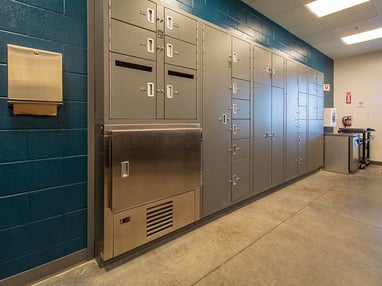
Controlled access starts at intake, the point where risk is highest and oversight is thinnest. Evidence lockers let officers deposit evidence directly into a secured zone without a hallway handoff, and features like wire gates let staff confirm what’s inside without opening the door. Dual-locking or interlocking mechanisms keep both sides from being accessed at once, so the chain of custody never has a gap to explain later.
Pro tip: Build in after-hours submission from day one. A pass-through locker doesn’t care what time a shift ends, and neither does a judge asking why an item sat in a patrol car overnight.
Climate Control by Evidence Type
One climate spec for the whole evidence warehouse is either overkill or a liability, depending on what’s on the shelf. Spacesaver’s whitepaper on storing biological evidence lays out four ranges worth designing around:
- Frozen: At or below 14°F
- Refrigerated: 36°F to 46°F, humidity under 25 percent
- Temperature-controlled: 60°F to 75°F, humidity under 60 percent
- Room temperature: Standard conditions for items that don’t need active control at all
Biological evidence degrades on its own schedule, and matching storage zone to evidence type protects the samples that need it without spending climate-control budget on the ones that don’t.
Pro tip: Decide the climate zone for each evidence category before you install shelving or lockers. A refrigerated locker retrofitted into a room built for dry storage costs more than one planned from the start.

Ventilation for Controlled Substances
Narcotics evidence off-gasses, and marijuana in particular carries mold risk from Aspergillus and other spores. Both are an exposure problem for anyone working the room, not just a storage problem.
Build to a clear standard: independent ventilation that doesn’t recirculate into the building’s general HVAC system, held under negative air pressure relative to adjacent spaces so contaminants can’t migrate into the rest of the building. The room needs its own air.
Pro tip: Add local exhaust, like a benchtop hood, at the point where technicians actively handle narcotics evidence. Room-level ventilation covers storage. It doesn’t cover the moment someone opens a bag.
Planning for High Volume Over Long Retention Periods
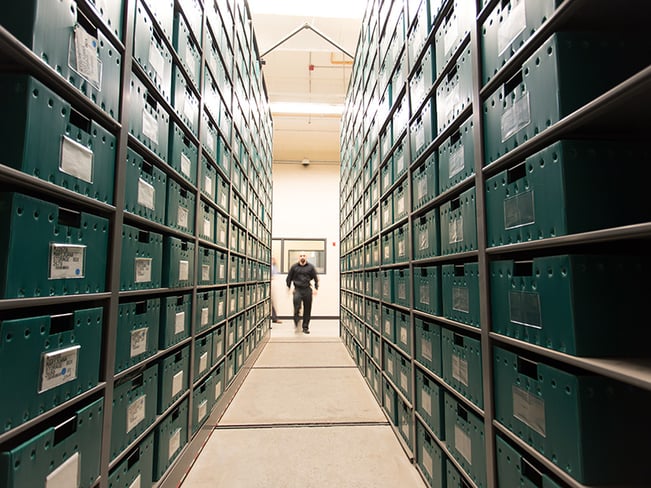
Retention schedules on major cases can run decades, and a warehouse sized for today’s volume is a warehouse that’s already behind. Two real examples show what planning ahead actually buys.
A Houston PD property room needed to accommodate close to a million distinct items, from jewelry to bicycles, without losing retrieval speed. Spacesaver’s ActivRAC® mobile racking system let them reduce the building’s footprint by roughly 30 percent without sacrificing capacity.
The Volusia County Sheriff’s Office faced a different version of the same problem: about 20,000 new items a year outgrowing a converted 1930s prison building with narrow doorways and occasional flooding, all while working to protect the CALEA accreditation they’d already earned. A Spacesaver high-bay mobile system, built out and automated for order picking, added roughly 40 percent more capacity in the new facility, with room to keep growing.
Pro tip: Size the mobile shelving aisles and rail runs for how much evidence you’ll have down the road, not just what you’re storing today. Add capacity later, and you’ll end up moving evidence twice.
Inventory Tracking at Scale
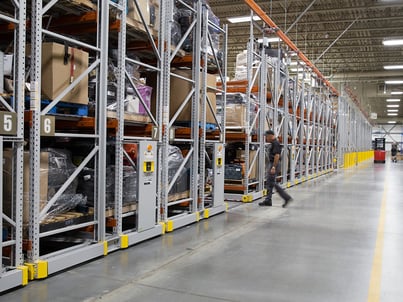
At a few thousand items, a spreadsheet and a diligent tech can find anything. But at a few hundred thousand, the system has
to do the finding. Item-level tracking, tied to a specific shelf, locker, or bin, stops a records request from becoming a week-long search.
The audit trail matters as much as the location data. Every access logged with a timestamp holds up when a defense attorney asks who touched an item and when. That trail should map to the access zones already built into the room, so a location code means something more than a shelf number.
Pro tip: Tag at intake. Evidence that enters the system untagged tends to stay that way until someone needs it in a hurry.
Get It Right the First Time
Effective off-site evidence storage comes down to five decisions:
- Who can access what
- How each evidence type is climate-controlled
- How the air moves
- How the room scales
- How anyone finds anything years from now
Get these decisions right the first time, and you’ll have a facility that can still hold up fifteen years from now.
Our evidence room storage page covers the shorter-range version of the same principles. If you’re planning an off-site evidence warehouse, Patterson Pope can help you evaluate your workflows and design a facility that’s built to last.