
Ammunition storage questions have a habit of showing up late, well after the floor plan is set. That’s when someone asks whether the ammunition needs its own room, a special cabinet, or a fire-rated wall around it. Whether the project is a new police station or a sheriff’s office renovation, that’s not a question worth answering for the first time at final inspection.
Existing facilities run into a version of the same problem, usually with less warning: an inventory that’s outgrown its ammo locker, a new training program, or a fire inspector who flags what’s on the shelves during a routine visit. In each case, what needs to change still comes down to what kind of ammunition is actually being stored.

Does Fire Code Treat All Ammunition the Same Way?
Fire code sorts ammunition-related material into four broad categories, and the rules get stricter as you move from finished cartridges to loose components:
- Small arms ammunition: Finished cartridges, typically packaged and shipped under the lowest-hazard explosives classification (1.4S). This is what most police armories and duty ammunition rooms hold, and it’s regulated the most
leniently.
- Smokeless propellant: Reloading powder, subject to quantity limits, container requirements, and location rules.
- Black powder: More sensitive than smokeless propellant, with tighter handling and storage rules.
- Small arms primers: Capped by quantity and required to stay in original manufacturer packaging, with rules separate from both ammunition and propellant.
ATF adds another layer here: its regulations exempt small arms ammunition from the magazine storage requirements that apply to bulk explosives, which is why a typical duty-ammo inventory doesn’t need an explosives magazine.
Pro tip: Sort your inventory into these four categories before any layout decisions get made. An armory that holds only packaged duty and training ammunition is a very different conversation with the fire marshal than one supporting an in-house reloading program.
What Are the Fire Code Requirements for Ammunition Storage at a Police Station?
For police stations, sheriff’s offices, and armories in most U.S. jurisdictions, ammunition storage falls under Chapter 56 of the International Fire Code (IFC), as adopted and amended by the state or city.
Requirements scale with the material types above: packaged small arms ammunition sits at the lenient end, while propellants and primers face quantity limits. But it’s ultimately the local fire marshal, as the authority having jurisdiction (AHJ), that makes the final call for a specific building.
Some jurisdictions carve out exceptions for law enforcement facilities acting in an official capacity, but how each one is worded and adopted varies. Don’t assume an exemption covers your facility until your fire marshal confirms it in writing.
Do You Need a Separate Room for Ammunition Storage in a New Police Station Design?
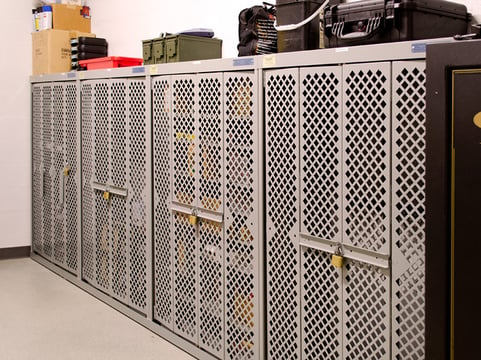
Fire code doesn’t usually require a dedicated room for packaged small arms ammunition at typical agency quantities. A separate room becomes more likely when quantities exceed what the AHJ allows for the occupancy, when the facility stores reloading propellants or primers, or when agency policy calls for one. That last driver matters more than most teams expect.
Many agencies separate ammunition from firearms by written directive rather than code, and accreditation programs like CALEA expect documented control and accountability for weapons and ammunition; physical separation is often the simplest way to show it.
Either way, settle the separate-room question before final layout decisions; a rated wall, dedicated access control, or a second door costs far less on the drawings than after the space is built.
What Type of Cabinet Is Required for Ammunition Storage in a Law Enforcement Facility?
Fire code generally doesn’t prescribe a specific cabinet for packaged small arms ammunition in a public safety facility. Code-specified cabinet construction comes into play for propellants and primers above certain quantities. There, the AHJ will define what’s acceptable.
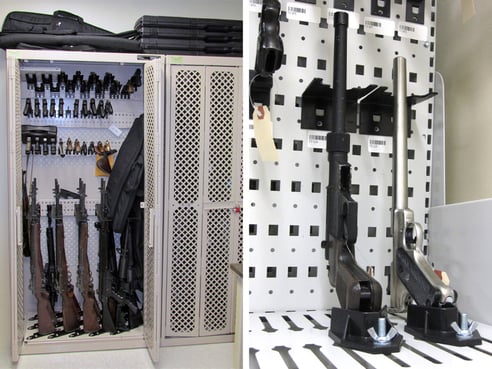
For duty and training ammunition, cabinet selection is driven by security and accountability: locking steel construction, restricted access, and a clear record of who opened what and when.
In practice, that means matching storage to how ammunition moves through the facility.
- Bulk and training stock usually lives on ammunition storage shelves inside the secured armory, static or high-density mobile, organized by caliber and lot.
- Issued and duty ammunition belongs in a locking ammo locker or modular gun safe near the weapons it’s issued with.
- Universal Weapons Racks and UWR Minis hold nearly any combination of handguns and long guns in that same space, keeping ammunition and firearms staged together without mixing storage systems.
Pro tip: Build lot tracking into the shelving layout. When a manufacturer recall hits, the goal is to pull one lot efficiently.
Who Makes Ammunition Storage Cabinets for Public Safety Facilities?
Ammunition storage cabinets for police departments and sheriff’s offices come from specialty storage manufacturers such as Spacesaver, whose weapons racks, gun lockers, and armory storage systems are built for public safety facilities. Most agencies buy them through regional dealers who handle design, specification, and installation.
Patterson Pope designs, supplies, and installs Spacesaver armory storage for public safety facilities, including ammo lockers, modular gun safes, weapons racks, tactical readiness lockers, and ammunition storage shelves.
The cabinet is only part of the answer. The rest is a layout—from weapons racks to modular shelving—that the fire marshal, the accreditation manager, and the armorer can all sign off on.
Planning Ammunition Storage That Holds Up
Ammunition storage compliance in a police station, sheriff’s office, or armory comes down to three questions:
- What kind of material is on the shelf?
- How much material is there?
- Who has to approve the plan?
Bring the fire marshal in early, with an inventory in hand, whether the project is a new build or a reworked armory.
Our weapons & gear storage page covers the full range of options. Talk to a Patterson Pope specialist before the floor plan is locked in, and we’ll help make sure it passes inspection the first time.